
For years, Marketing Qualified Leads (MQLs) have been the standard metric for measuring success in B2B marketing. A prospect who downloaded an ebook, attended a webinar, or completed a contact form was often considered ready for the next stage of the sales process. Marketing teams celebrated higher MQL numbers, while sales teams expected those leads to become customers.
That approach no longer reflects how businesses make purchasing decisions. Today’s buyers spend more time researching independently, comparing solutions, reading reviews, and consulting colleagues before they ever speak with a sales representative. By the time a prospect fills out a form, much of the buying journey has already taken place.
This shift has changed how successful organizations evaluate marketing performance. Instead of focusing only on Marketing Qualified Leads, companies now measure qualified pipeline, account engagement, intent data, and revenue contribution. These metrics provide a better understanding of which marketing activities influence purchasing decisions and contribute to long-term business growth.
In this guide, you’ll learn why MQLs are no longer enough, what has changed in modern B2B buying, and which strategies leading organizations now use to measure marketing success.
What Are Marketing Qualified Leads (MQLs)?
A Marketing Qualified Lead (MQL) is a prospect who has shown enough interest in a company’s product or service to receive additional attention from the sales team. Marketing automation platforms typically assign points to different customer actions and convert those interactions into a lead score.
Common actions that generate an MQL include:
- Downloading an ebook
- Registering for a webinar
- Requesting a brochure
- Completing a contact form
- Subscribing to a newsletter
- Visiting product pages several times
Once a lead reaches a predefined score, it is passed to sales for follow-up.
This system helped companies organize their sales funnel and evaluate campaign performance. However, lead scoring only measures engagement with marketing content. It does not always indicate whether a company is actively planning to purchase a solution.
Why MQLs Are No Longer Enough?
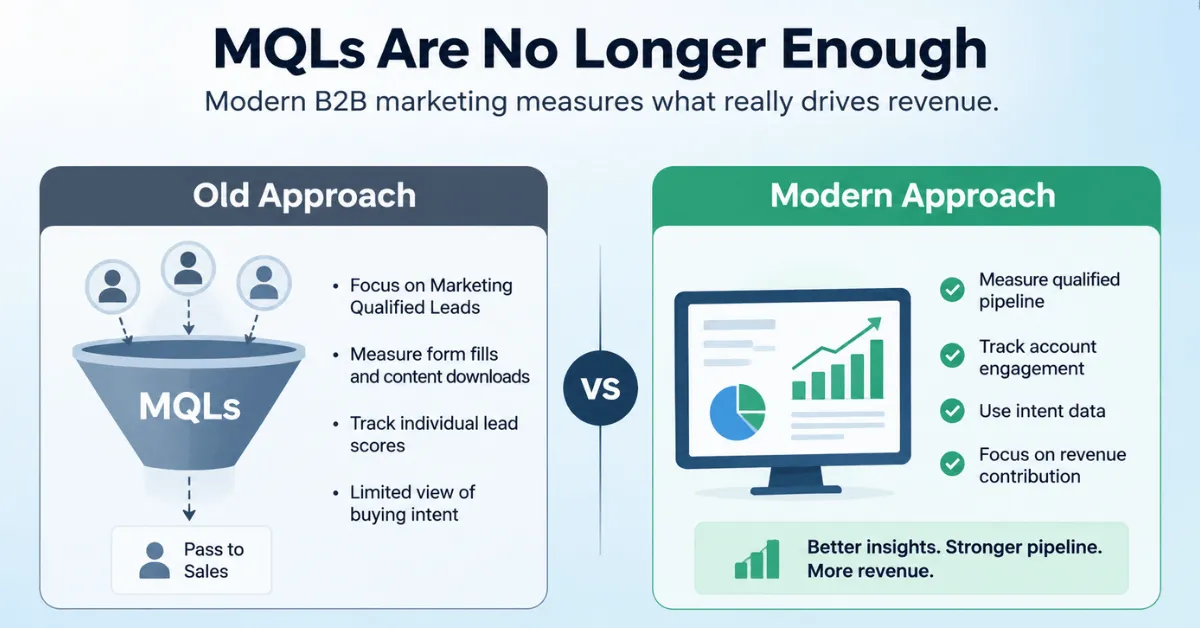
The decline of Marketing Qualified Leads (MQLs) is the result of several changes in buyer behavior, technology, and revenue measurement. Modern organizations need more accurate ways to identify genuine buying intent.
Buyers Complete Most Research Before Contacting Sales
The internet has fundamentally changed the B2B buying process.
Instead of relying on sales representatives for product information, buyers now research independently using:
- Search engines
- Product review websites
- Industry reports
- Customer case studies
- Comparison articles
- AI-powered search platforms
- Professional communities
Many decision-makers complete 70–80% of their evaluation before contacting a vendor. By that stage, they often understand pricing, product capabilities, and competitor differences.
This means that downloading one ebook or attending one webinar no longer provides enough information to determine purchasing intent.
Creating content that answers buyer questions throughout the research process has become far more valuable than simply increasing form submissions. Businesses investing in Intent-Based Search SEO attract visitors whose searches indicate genuine commercial interest rather than casual curiosity.
Buying Committees Have Replaced Individual Decision-Makers
Enterprise purchases rarely depend on one individual.
Today’s purchasing decisions often involve buying committees that include executives, finance teams, procurement specialists, IT departments, security professionals, and operational managers.
Each stakeholder evaluates a different aspect of the purchase.
- Executives assess business value.
- Finance reviews budgets and return on investment.
- IT evaluates security and compatibility.
- Procurement negotiates contracts.
- Department managers compare features and usability.
Because several people influence the final decision, tracking one Marketing Qualified Lead (MQL) provides only a partial view of buying intent.
Modern organizations increasingly monitor account engagement, measuring how multiple stakeholders interact with marketing content instead of relying on one lead score.
According to research from Gartner, B2B buying decisions commonly involve multiple stakeholders, making account-level engagement a more reliable indicator of purchasing readiness than individual lead activity.
Intent Data Provides Better Buying Signals
Traditional MQL scoring measures marketing activity.
Intent data measures buying behavior.
For example, downloading a white paper may simply indicate curiosity.
However, when multiple employees from the same organization repeatedly:
- Visit pricing pages
- Compare competing products
- Download implementation guides
- Read technical documentation
- Watch product demonstrations
- Return several times within a short period
the account demonstrates much stronger commercial intent.
Instead of evaluating isolated interactions, intent data combines behavioral signals to identify organizations actively researching solutions.
Marketing and sales teams can then prioritize these accounts instead of contacting every person who downloads a resource.
If you’re developing an intent-focused content strategy, our guide to Intent-Based Search SEO explains how matching content with search intent improves both SEO performance and lead quality.
Artificial Intelligence Improves Lead Qualification
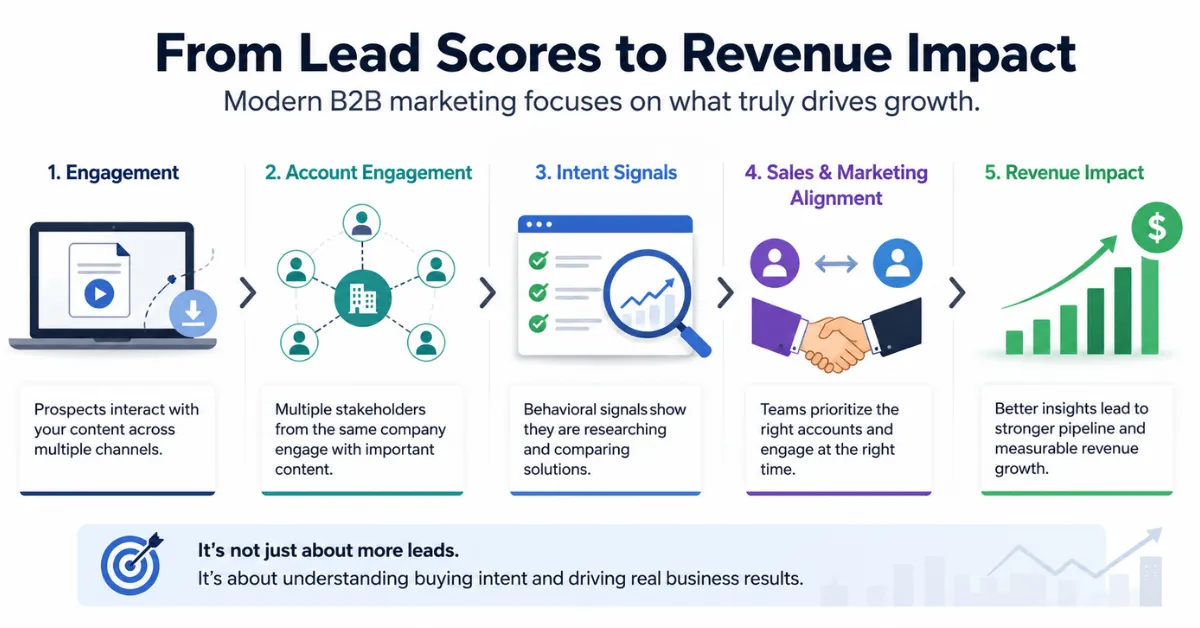
Artificial intelligence has changed how businesses evaluate potential customers.
Instead of relying on simple lead scores, AI analyzes information from multiple sources, including CRM records, website behavior, email engagement, product usage, and intent data.
This allows businesses to identify patterns that manual scoring often misses.
AI is commonly used for:
- Lead prioritization
- Pipeline forecasting
- Customer segmentation
- Marketing attribution
- Personalized outreach
- Opportunity scoring
Rather than replacing marketing and sales professionals, AI helps teams focus their time on accounts with stronger buying signals.
Companies investing in AI Citations are also improving their visibility within AI-powered search experiences, where many business buyers now begin researching products and services.
What Is Replacing MQLs?
Businesses are not abandoning lead generation—they are replacing outdated success metrics with measurements that better reflect revenue potential.
The comparison below highlights this shift.
| Traditional MQL Model | Modern B2B Growth Model |
|---|---|
| Lead volume | Qualified Pipeline |
| Individual lead scoring | Account Engagement |
| Form submissions | Intent Data |
| Marketing KPIs | Shared Revenue Metrics |
| Email open rates | Pipeline Contribution |
| MQL count | Revenue Attribution |
Account-Based Marketing (ABM)
Account-Based Marketing (ABM) focuses on organizations instead of individual contacts.
Marketing and sales teams identify high-value accounts together, understand their business challenges, and deliver personalized content that addresses different decision-makers within the same company.
Because enterprise purchases involve multiple stakeholders, ABM provides a more realistic approach than measuring the activity of a single lead.
Revenue Operations (RevOps)
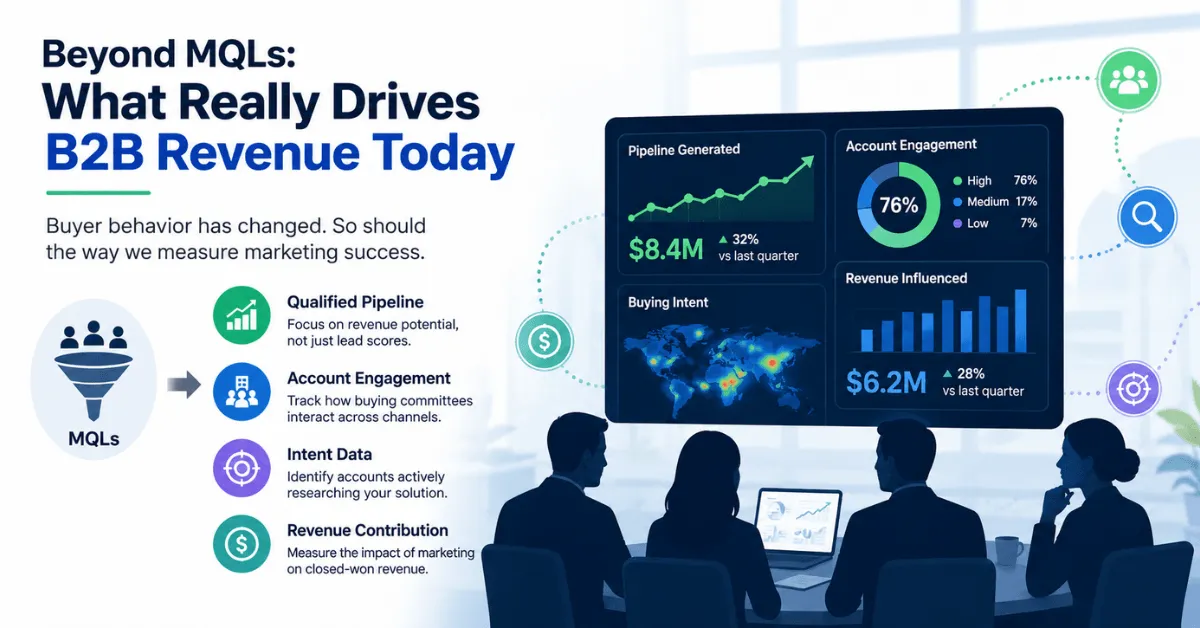
Revenue Operations (RevOps) aligns marketing, sales, and customer success around shared business goals.
Instead of using different reporting systems and separate KPIs, every department works from the same customer data and revenue metrics.
This alignment improves reporting accuracy, customer experience, and collaboration throughout the buying journey.
Qualified Pipeline
One of the biggest changes in modern B2B marketing is the shift from measuring lead volume to measuring qualified pipeline.
Instead of asking:
“How many MQLs did marketing generate?”
High-performing organizations ask:
“How much qualified pipeline did marketing influence?”
Measuring qualified pipeline connects marketing activities with revenue opportunities, making it easier to evaluate campaign performance and allocate budgets more effectively.
How to Move Beyond MQLs?
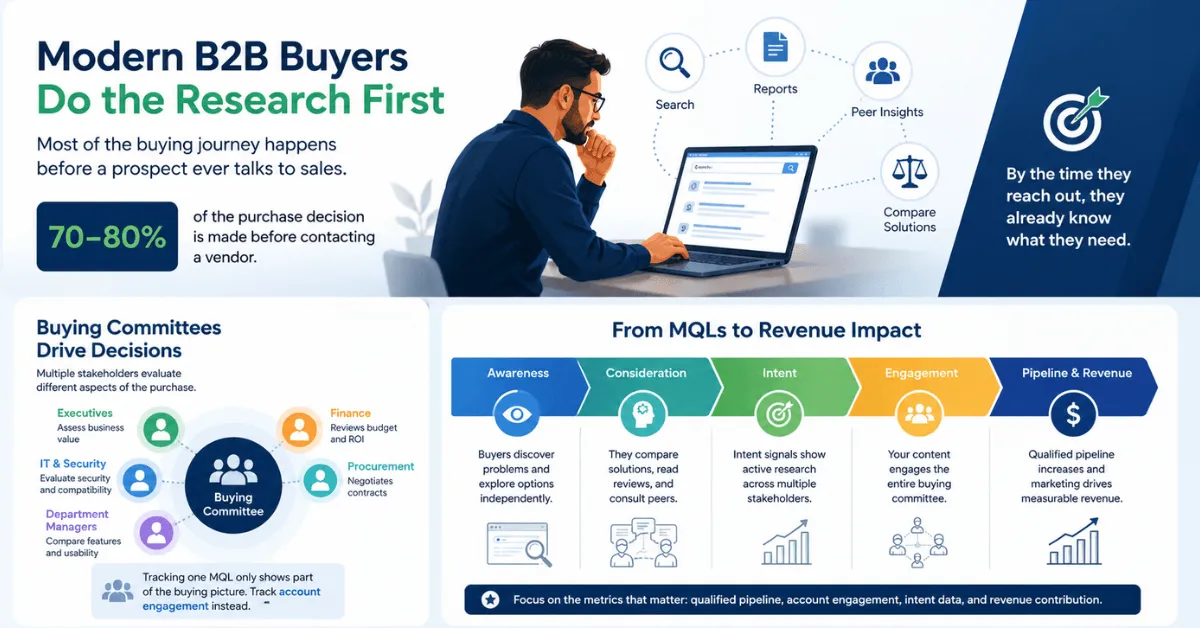
Replacing Marketing Qualified Leads (MQLs) does not mean eliminating lead generation. Instead, it means measuring success with metrics that better reflect how modern buyers research, evaluate, and purchase products. Organizations that combine lead generation with qualified pipeline, intent data, and account engagement gain a more accurate view of marketing performance and revenue potential.
Measure Qualified Pipeline Instead of Lead Volume
Lead volume shows how many prospects entered your funnel, but it does not reveal how many became real sales opportunities. Measuring qualified pipeline helps marketing and sales focus on prospects that have a realistic chance of becoming customers.
Track performance using metrics such as:
- Qualified Pipeline
- Sales Qualified Opportunities (SQOs)
- Pipeline Velocity
- Win Rate
- Revenue Attribution
- Customer Lifetime Value (LTV)
These metrics provide a clearer connection between marketing activities and business growth than MQL volume alone.
Build Content for Every Stage of the Buying Journey
Today’s buyers expect answers before speaking with sales. Creating useful content for every stage of the buying journey helps establish trust and supports informed purchasing decisions.
Content That Supports B2B Buyers
Consider publishing:
- Product comparison articles
- Pricing guides
- Customer case studies
- Implementation guides
- Industry research
- Frequently asked questions
- Technical documentation
- ROI calculators
Instead of producing content only to collect contact details, focus on helping buyers solve problems and evaluate solutions.
Website performance also influences user experience. Faster pages improve engagement and reduce abandonment, particularly for visitors comparing multiple vendors. Optimizing your website according to the 3-Second Rule can improve both user experience and conversion rates.
Use Intent Data to Prioritize Accounts
Not every website visitor is ready to buy.
Intent data helps identify organizations showing stronger purchasing signals by monitoring activities such as:
- Returning visits
- Pricing page views
- Competitor comparisons
- Demo requests
- Technical documentation downloads
- Engagement from multiple employees within the same company
When several buying signals appear together, marketing and sales teams can prioritize those accounts instead of contacting every Marketing Qualified Lead (MQL).
Align Marketing and Sales Around Shared Goals
Many companies struggle because marketing and sales measure success differently. Marketing focuses on lead generation, while sales focuses on revenue.
Successful organizations align both departments by using shared metrics, including:
- Qualified pipeline
- Revenue attribution
- Opportunity creation
- Win rate
- Customer retention
This alignment is often supported through Revenue Operations (RevOps), giving every team access to the same customer data and reporting dashboards.
Review Performance and Adjust Regularly
Buyer behavior, search trends, and technology continue to change. Reviewing marketing performance regularly helps identify which campaigns contribute to pipeline growth and which strategies require improvement.
Monthly or quarterly reviews should examine:
- Content performance
- Pipeline contribution
- Revenue attribution
- Channel effectiveness
- Account engagement
- Customer acquisition costs
Making small improvements over time often produces stronger long-term results than relying on a single performance metric.
Common Mistakes to Avoid
Many organizations recognize the limitations of Marketing Qualified Leads, but replacing them without a clear strategy can create new challenges.
Treating Website Traffic as a Success Metric
Traffic growth is encouraging, but visitors alone do not generate revenue. Always evaluate whether campaigns create qualified opportunities rather than focusing only on page views or sessions.
Passing Every Lead to Sales
Sending every MQL directly to sales often wastes time and reduces productivity. Combining intent data with account engagement helps identify prospects that deserve immediate attention.
Ignoring Buying Committees
Enterprise purchases rarely involve one decision-maker. Measuring activity across an entire account provides a more complete picture than tracking a single contact.
Measuring Marketing and Sales Separately
Different reporting systems often produce conflicting priorities. Shared KPIs improve collaboration and provide a clearer understanding of business performance.
Depending Entirely on AI
Artificial intelligence can identify patterns and prioritize opportunities, but it should support human decision-making rather than replace it. Marketing and sales professionals still need to understand customer requirements, validate opportunities, and build relationships.
Frequently Asked Questions
Are Marketing Qualified Leads (MQLs) still relevant in 2026?
Yes. Marketing Qualified Leads (MQLs) remain useful for identifying interested prospects, especially for businesses with shorter sales cycles. However, many B2B organizations now combine MQLs with qualified pipeline, intent data, and account engagement to measure marketing performance more accurately.
What is replacing MQLs in B2B marketing?
Many organizations now rely on Account-Based Marketing (ABM), qualified pipeline, Revenue Operations (RevOps), revenue attribution, and intent data instead of measuring success solely by lead volume.
Why is intent data important?
Intent data identifies behaviors that indicate active buying interest, including pricing page visits, competitor comparisons, repeated website visits, and demo requests. These signals provide stronger evidence of purchase intent than individual marketing interactions.
What is Account-Based Marketing (ABM)?
Account-Based Marketing (ABM) is a strategy that targets high-value organizations rather than individual leads. Marketing and sales collaborate to engage multiple stakeholders throughout the buying process, improving pipeline quality and conversion rates.
Does AI replace traditional lead scoring?
AI improves lead qualification by analyzing customer behavior, CRM activity, and intent data. However, it works best alongside experienced marketing and sales teams that can validate opportunities and understand customer needs.
Conclusion
Marketing Qualified Leads (MQLs) are not obsolete, but they are no longer enough to measure marketing success in today’s B2B environment. Buyers complete more research independently, purchasing decisions involve multiple stakeholders, and buying signals appear across many digital touchpoints long before a prospect submits a contact form.
Organizations that measure qualified pipeline, Account-Based Marketing (ABM) performance, intent data, and Revenue Operations (RevOps) gain a more accurate understanding of marketing’s contribution to revenue. These metrics help marketing and sales prioritize high-value accounts, improve collaboration, and invest in campaigns that create measurable business outcomes instead of simply increasing lead volume.
As B2B buying continues to evolve, companies that focus on buyer intent, account engagement, and revenue impact will be better positioned for sustainable growth than those that rely solely on Marketing Qualified Leads. Building helpful content, improving search visibility, and adapting to changing buyer behavior will continue to play an important role in attracting qualified prospects and supporting long-term business success.